In the capital, there are buildings and places known not only for their architecture or historical events but also for stories that have been passed down orally for decades. The Sulyma Mansion, the NKVD underground prison, the “House with Cats,” the demonic mascaron in Bekhterevsky Lane, the mysteries of the Main Post Office, and the toxic legacy of the Radical factory — together, they form a map of places where every corner has a story worth hearing at least once.
The Yakym Sulyma Mansion: The Ghost That Did Not Forgive
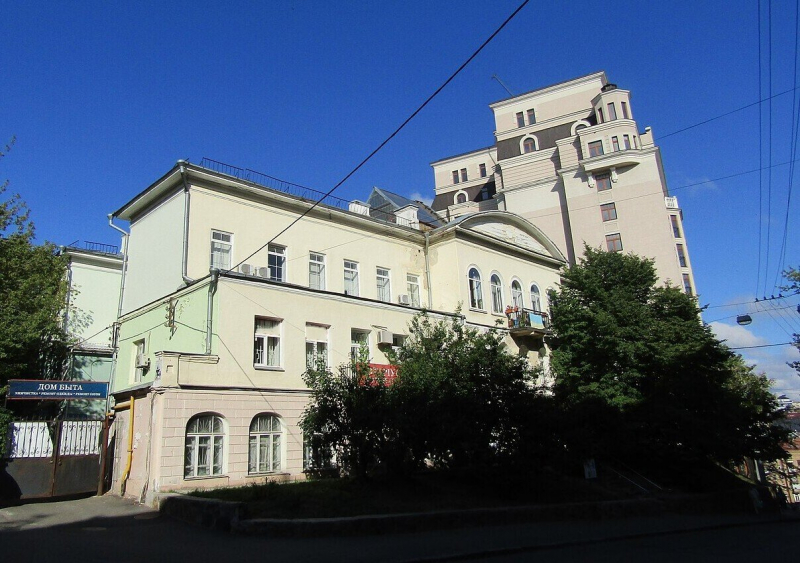
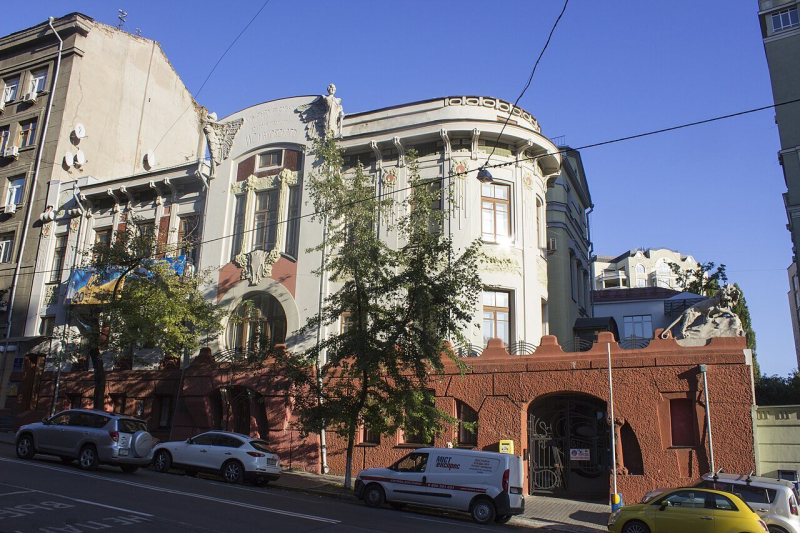
At 16 Lutheran Street stands a building that one can easily walk past without realizing its past. Today, it houses offices, but it was once the luxurious mansion of Yakym Sulyma — one of the most mysterious houses in Kyiv.
In the 1830s, architect Ludwik Stanzani designed the estate for Yakym Sulyma, who was himself interested in architecture and actively participated in the project. The house featured a six-column portico, a dome, symmetrical staircases, and terraces that descended the slopes of Spiral Hill toward Bessarabka. Inside were 37 rooms, wings, and a planned garden with a vineyard.
In 1840, Sulyma died under unclear circumstances. The mansion passed to his widow, who later married General Mykola Lovtsov. It was then that residents began reporting strange sounds, moans, and a white figure in the windows — supposedly the angry spirit of Sulyma.
They say that after his wife’s remarriage, General Lovtsov lived there only briefly and then suddenly died. Later, Ulyana also passed away. The building was eventually turned into a shelter for the poor, and in 1866, the Alexander Nevsky Church was built in one of its wings. After the consecration, the ghost seemed to disappear, but other strange occurrences appeared — pebbles and small objects would fall on people.
In 1896, a major fire broke out in the estate. The fire destroyed the wooden parts, but a white silhouette was seen in the stone section — Kyiv residents were convinced it was the figure of Sulyma.
After reconstruction, the shelter continued to operate for a while, and from 1928, the building housed communal apartments, offices, and shops. Yet the city remembers its legends well. It is said that Sulyma’s jealous ghost still does not leave his mansion.
The NKVD Underground Prison: Kyiv’s Labyrinth That Was Hidden for a Long Time
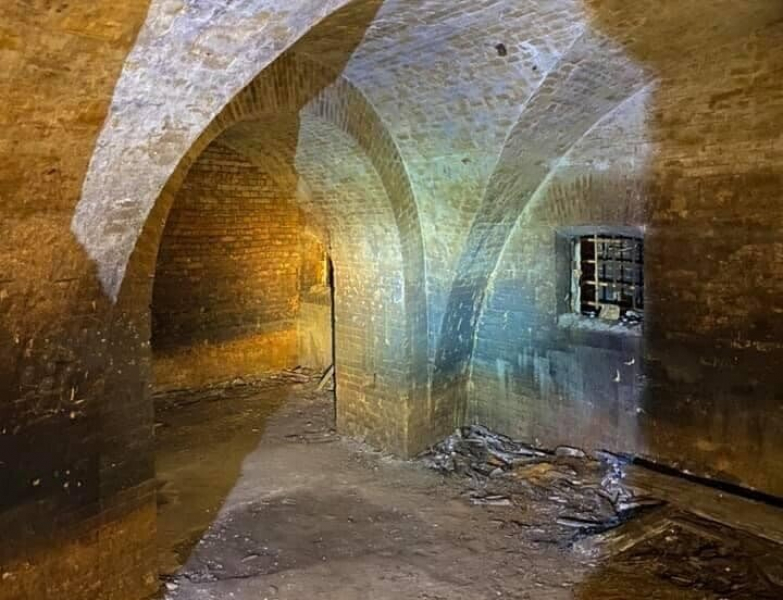
At the intersection of Kudri Street and Chygorina Street, directly beneath modern residential buildings, lies one of Kyiv’s most terrifying underground sites — the secret prison of the USSR’s People’s Commissariat of Internal Affairs. Its existence was kept secret for years, and the entrance remained closed even after the fall of Soviet power.
The history began in the 19th century when a massive fortress was being built in Pechersk. The prison built in 1818 fell within the area of the future ramparts. It was supposed to be demolished, but it was eventually incorporated into the fortification system, making escape virtually impossible.
The underground chambers came back into discussion in modern times. During the construction of a luxury skyscraper, workers discovered a bricked-up passage. After breaking the walls and pumping out water, archaeologists discovered an intact complex of cells — with hooks, bars, and inscriptions on the walls. Most of them date from the 1920s–1930s, but there are also post-war ones left by German prisoners of war.
Today, the NKVD underground prison is part of Kyiv’s “Kyiv Fortress.” The site is open for tours, and these visits rarely leave anyone indifferent: the atmosphere has remained almost the same as it was a hundred years ago.
“The House with Cats”: Kyiv Modernism That Turned into a City Legend
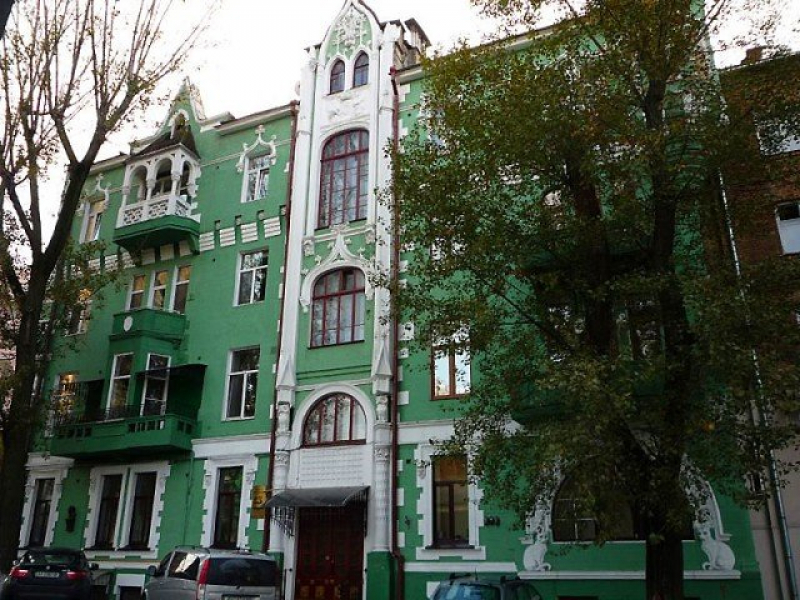
At 23 Hoholivska Street stands a building long nicknamed by Kyiv residents as the “House with Cats.” It was once even more dramatically called the “Koschei Castle.” The mansion indeed stands out with such whimsical decoration that even today it is hard to pass by unnoticed.
Built in 1909 by architect Volodymyr Bezmertnyi, the house became one of his boldest works. Although the future chief architect of Kyiv usually worked in more restrained styles, here he combined Modernism with Gothic elements and complete asymmetry of the façade. For a long time, there was a legend that the house actually belonged to Vladyslav Horodetsky — but archival documents have debunked this urban myth.
The client was Colonel Fedor Yahymovsky, who served in Lithuania. Perhaps it was the local architecture there that inspired him toward medieval motifs. The mansion has a T-shaped layout, green walls, white decorative elements, and various shapes of windows and balconies. The stained-glass windows, located almost at ground level, caused debates at the beginning of the 20th century — but later became a recognizable feature of the house.
The sculptural decoration attracts the most attention. By the entrance stand figures of owls; above the large window are bas-reliefs of cats with green eyes and red mouths. At the very top of the façade is an image of a devil, under which is placed the Yahymovsky family coat of arms. Among the decorative elements are mascarons with various facial expressions, which only fueled the imagination of Kyiv residents.
Over the century, notable people lived in the house: historian and ethnographer Mykola Levchenko, and scientist Stepan Tymoshenko, in whose honor a commemorative plaque was installed on the façade. Yet alongside documented facts, other stories circulated in the city for decades — about the supposed fatal influence of the house and the “dangerous” aura of its residents.
The Mysterious Ruin with a Demon’s Head: What Hides in the Courtyards of Bekhterevsky Lane
Ruins of a Late 19th-Century Manor
8-B Varyazhsky Lane
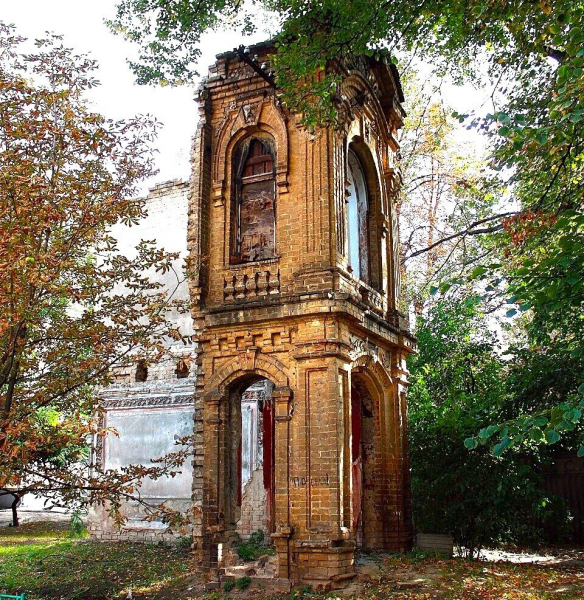
In Varyazky Lane, very close to the Pokrovsky Monastery, one can come across a ruin that not all Kyiv residents know about. Deep in the courtyards stands a solitary portico — the last fragment of a late 19th-century mansion built according to a design by architect Volodymyr Nikolaev. At one time, governors-general lived here, and later Ivan Nechuy-Levytsky rented a room. In the early 1980s, the movie “Racing Upwards” was filmed in the house, and in 1986 the ruin was added to the list of cultural heritage sites.
How exactly the building disappeared remains a mystery even for the neighbors. No exact version has been preserved. There were rumors that the remains would be reinforced and turned into a literary café, but years passed, and the plans never went beyond conversations.
Today, attention is drawn not only to the portico itself but also to the mascaron on its wall — the head of a demon with a whimsical, almost smiling grimace. It has become the most famous detail of the lost building and its unofficial symbol.
“The Pipe” on Maidan: A Passage Built on the Site of an Ancient Swamp
“Truba” on Independence Square
Independence Square
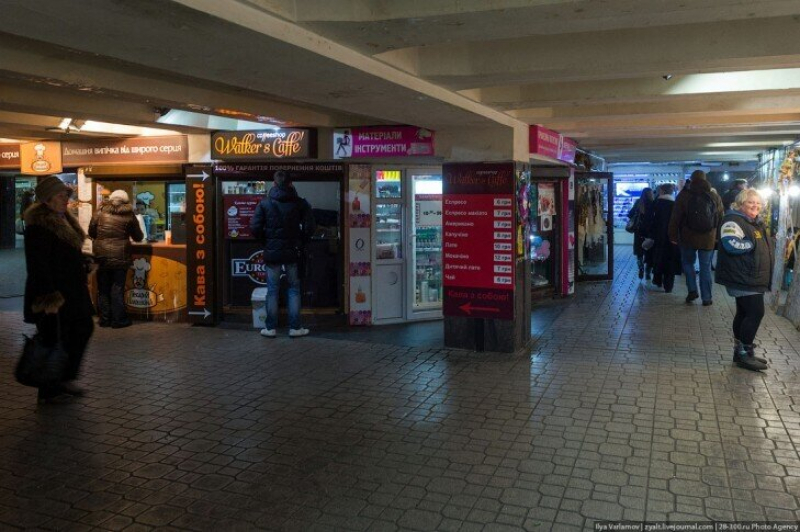
The underground passage near the Main Post Office, known among Kyiv residents as “The Pipe,” has a much older history than it may seem. Once, this location was the Goat Swamp — an area considered “unclean” by our ancestors. It seemed that devils lived here, and people tried to avoid this area.
Today, the swamp territory is owned by the Kyiv Metro, but some passersby still say they feel depressed here, as if the place retains its ancient energy.
Next to the passage is another creepy Kyiv story. On the site of the current Main Post Office once stood the profitable house of a burgher woman, Olga Dyakonova. She complained that furniture moved by itself and objects flew around the house. Dyakonova was fascinated by Spiritualism — a fashionable pastime in the early 20th century — and occasionally held seances, after which, according to the owner, strange occurrences would begin in the house.
At first, she invited a priest to bless the premises, but that did not help. Then the woman contacted the police. Law enforcement recorded the “strange events” in the report, and eventually the house was sealed. In 1941, it was demolished, and later the Main Post Office was built on this site.
The Radical Factory: An Abandoned Territory with a Dangerous Past
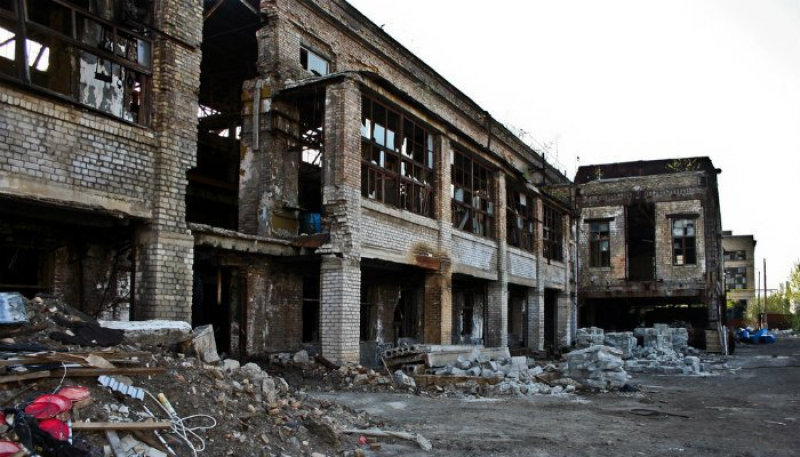
At 61 Chervonotkatska Street lies one of Kyiv’s most famous “forgotten” zones — the territory of the former Radical Chemical Plant. Today, it is empty buildings, fragments of laboratory equipment, and rusted structures, but the real danger lies not in the atmosphere, but in the legacy of production.
The enterprise operated from 1951 and was one of the few in the USSR that used large amounts of mercury. After operations ceased in 1996, the chemical residues were not removed: hundreds of tons of mercury, acids, and industrial waste remained in the soil and buildings. This turned “Radical” into one of the most toxic sites in the capital.
In the 2000s, the plant went through bankruptcy and court proceedings, and in 2002 it was officially recognized as an especially hazardous chemical facility. The area remains contaminated, and specialists record elevated levels of mercury in the air and soil.
Even experienced urban explorers are advised not to enter — the health risks are too high. The city plans to clean the area, but for now, “Radical” remains a grim reminder of Kyiv’s industrial past and the consequences of neglecting environmental safety.
The Lion Cub That Chases Away Death: Guardian of the House on Honchara Street
At 33b Oles Honchar Street stands one of the most striking examples of Kyiv’s Austrian Modernism — the former Makovsky Clinic. The small but extremely imaginative building by architect I. Ledokhovskyi was originally designed for medical doctor P. Kachkovskyi. After his death, the building was inherited by a colleague, physician Ihnat Makovsky, who turned it into one of the most modern surgical clinics of the early 20th century.
One detail draws attention and makes the building recognizable: a small stone lion cub stands near the façade. It was intended to guard the house and ward off evil.
It was in this clinic, following an assassination attempt at the Kyiv Opera, that the Prime Minister of the Russian Empire, Pyotr Stolypin, died.
In the 1990s, the building housed the main office of the People’s Movement of Ukraine. The party moved here shortly before the death of its leader Vyacheslav Chornovil in 1999.
Today, the lion cub still stands by the entrance — a small stone guardian that has outlived all its owners and has become a symbol of the building’s complex fate on Honchara Street.
Despite their different themes and scales, all these places have one thing in common — they help you feel Kyiv as layered, mysterious, and full of stories that still live in its streets and courtyards. And if you want to see another side of the city — calmer, inspired, and focused on art — check out our selection of “6 Places for Inspiration: Kyiv Museums and Galleries Worth Visiting on Weekends.” It’s a great way to continue exploring the capital and discover new points of connection with its culture.